Temporary Anchorage Devices in Norwalk, CT
A small anchor for more precise tooth movement.
Temporary anchorage devices (TADs) are tiny screws placed briefly in the bone to give braces or aligners a steady point to pull from, planned by orthodontist Dr. May Kim.
Serving patients in Norwalk and throughout Fairfield County.
Planned by an Orthodontist

Dr. May Kim, DDS
Orthodontist
Dr. Kim decides whether an anchor will help your case and plans exactly where it goes, so the teeth you want to move can move and the rest stay where they are.
DDS, New York University, with Honors in Orthodontics. Orthodontic certificate, Montefiore Medical Center. Member, American Association of Orthodontists.
Meet Dr. KimA Small Anchor That Helps Teeth Move Precisely
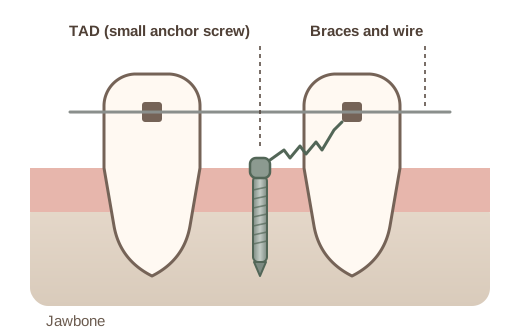
A temporary anchorage device, or TAD, is a tiny titanium screw that is placed in the jawbone for the length of one specific tooth movement and then removed. Because it stays put, it gives your braces or aligners a steady point to pull against.
Normally, other teeth have to act as the anchor, and they can drift when they are pulled on. A TAD takes over that job, so treatment can be more precise.
Common Reasons for a TAD
Closing Gaps
Closing space after teeth are removed without the back teeth drifting forward.
Pulling Teeth Back
Moving teeth or molars backward to relieve crowding or correct an overbite.
Moving Teeth Up or Down
Gently moving teeth to correct an open bite, a deep bite or a gummy smile.
Guiding Impacted Teeth
Giving a firm point to pull an impacted tooth into place.
Exposure of Impacted Teeth →Straightening Tipped Molars
Uprighting a leaning molar, often to prepare for a bridge or implant.
Less Extra Hardware
In many cases, a TAD can take the place of headgear and reduce the need for rubber bands.
From Planning to Removal
Planning
Dr. Kim reviews your records and imaging and decides where an anchor will help.
Placement
The spot is numbed and the TAD is placed in a short visit. Many patients feel pressure rather than sharp pain, and mild soreness afterward is common.
Using the Anchor
Dr. Kim attaches a small spring, elastic or wire from the TAD to your braces or aligners, and adjusts it at your visits.
Removal
When the movement is finished, the TAD is removed in a quick visit and the spot heals on its own.
Temporary Anchorage Devices FAQ
No. A TAD is temporary by design, and it is removed once it has done its job.
The area is numbed first, so many patients feel pressure instead of sharp pain during placement. Some soreness afterward is common and usually settles within a few days.
It depends on the tooth movement it is helping with, and it is often several months. Dr. Kim will tell you what to expect for your case.
Brush gently around it, keep the area clean and avoid picking at it or pushing on it with your tongue or fingers.
Occasionally. If it feels loose, call us, and it can often be replaced.
Most orthodontic patients do not. Dr. Kim recommends one only when it will make your treatment more precise or more comfortable.
Curious Whether a TAD Could Help?
Book an orthodontic consultation and Dr. Kim will talk through your options.